
Views: 0 Author: Site Editor Publish Time: 2026-02-17 Origin: Site


Why does a dull strip glow at night? Why does Reflective Tape shine so bright? It looks plain in daylight. At night, it seems to light up. The reason is retroreflection. Light returns to its source.
In this article, you will learn how Reflective Tape works, its inner structure, and what controls visibility.
To understand how Reflective Tape works, it helps to compare it with familiar reflective surfaces. A mirror reflects light according to the law of reflection: the angle of incidence equals the angle of reflection. This means light striking a mirror is redirected outward at a predictable angle. Matte or rough surfaces behave differently; they scatter incoming light in multiple directions, producing diffuse reflection. In both cases, light does not intentionally return to its source.
Retroreflection follows a different geometric principle. Instead of scattering or redirecting light away, Reflective Tape sends incoming light back toward its origin. In practical terms, when headlights strike trailer reflective tape on the rear of a vehicle, the brightest return is seen by the driver whose lights are illuminating it. The reflected beam travels along a path nearly parallel to its entry direction, producing a concentrated return that appears significantly brighter than ordinary reflection. This is why high-performance products such as 3M reflective tape are widely used in transportation safety systems.
Surface Type | Light Behavior | Visibility to Light Source | Visibility to Side Observer |
Mirror | Reflects at equal opposite angle | Moderate | Low |
Matte Surface | Scatters in many directions | Low | Low |
Reflective Tape | Returns light to original direction | High | Reduced |
Because the returning beam is concentrated rather than dispersed, perceived brightness increases dramatically for observers aligned with the light source. This directional return forms the basis of highway markings, trailer reflective tape applications, and industrial safety identification.
Night conditions amplify the effect of retroreflection. When ambient light decreases, the contrast between darkness and returned light becomes more pronounced. Reflective Tape does not emit light; it becomes visible only when illuminated by an external source such as vehicle headlights, flashlights, or work lamps.
Alignment plays a critical role. When a driver’s eyes are positioned close to the vehicle’s headlights, both are nearly on the same optical axis. Light emitted from the headlights strikes the tape and is redirected back along that same path. Because the driver’s eyes are near the source, they fall within the returning beam and perceive strong brightness. A person standing to the side may observe reduced illumination because they are outside the main return path. This explains why trailer reflective tape appears brightest directly behind a vehicle at night.
Unlike glow-in-the-dark materials, Reflective Tape works purely through geometry and optical design. Its performance depends entirely on incoming light and the internal structure that redirects it. Even advanced materials such as 3M reflective tape rely on this same retroreflection principle rather than stored energy.
Key nighttime visibility factors include:
● High contrast between returned light and dark surroundings, increasing detection distance.
● Directional light return that focuses brightness toward drivers instead of scattering it.
● Passive operation that requires no power source, wiring, or maintenance.
At the microscopic level, the Reflective Tape light reflection mechanism involves both refraction and internal reflection. When light enters the transparent outer layer, it bends due to a change in refractive index. This bending guides the beam toward internal optical elements such as glass beads or microprisms.
In bead-based systems, light refracts into a spherical bead, reflects off a metallic backing layer, and exits along a path close to its original direction. In prismatic systems, light enters a cube-corner prism and reflects internally across multiple perpendicular faces before exiting parallel to its entry path. High-grade materials—including many forms of 3M reflective tape—use microprismatic geometry to maximize light return efficiency.
The mechanism can be summarized in three stages:
1. Entry and Refraction – Light bends as it passes into the optical layer.
2. Internal Reflection – The beam strikes a reflective surface or prism face and changes direction.
3. Exit Toward Source – The beam leaves the structure traveling back toward the original light source.
Because millions of microscopic elements operate simultaneously, the combined effect produces the bright, uniform glow seen on trailer reflective tape and roadway markings.
The brightness of Reflective Tape depends heavily on geometry. Two key angles determine performance: the entrance angle (the angle at which light strikes the surface) and the observation angle (the angle between the viewer’s eyes and the light source). Small variations in these angles can significantly influence perceived intensity.
When the observation angle increases—meaning the viewer moves farther from the light source—the returning beam may no longer align precisely with the viewer’s eyes. As a result, the tape appears dimmer. This explains why reflective markings are brightest when viewed directly from a vehicle and less intense when viewed from an offset position.
The returned light forms what is commonly described as a “cone of reflectivity.” As light exits the tape, it spreads outward in a cone-shaped pattern centered on the light source. Anyone positioned within this cone perceives strong illumination, while those outside it see reduced brightness.
To visualize this relationship:
● Light source and eyes closely aligned → Maximum brightness
● Light source present but observer offset → Reduced brightness
● No light directed at tape → No visible reflection
Glass bead–based Reflective Tape relies on a layered optical construction designed to control how light travels through the material. At its core are thousands—or more accurately, millions—of microscopic spherical glass beads embedded within a transparent polymer layer. These beads are uniformly distributed across the surface to ensure consistent retroreflection across the entire tape width. The outer layer must remain optically clear so incoming light can pass through without distortion before interacting with the beads.
Behind the beads sits a reflective backing layer, often metallic or specially coated, which acts as a return surface. This backing is critical because it redirects light that has passed through the bead toward the original source. Without this reflective layer, much of the light would be lost within the substrate. Beneath the optical and reflective components lies the adhesive layer and structural backing film. These layers do not influence light directly but maintain bead alignment, surface stability, and long-term durability under environmental stress.
A simplified structural overview:
Layer Component | Primary Function | Optical Role |
Transparent Top Film | Protects beads from abrasion and weather exposure | Allows light entry |
Glass Bead Layer | Controls refraction and direction of light | Core retroreflection element |
Reflective Backing | Returns refracted light toward source | Internal reflection surface |
Adhesive & Support Film | Ensures surface bonding and structural stability | Non-optical support |
This layered system operates as a unified optical assembly rather than independent parts. Each layer must maintain alignment for the retroreflection process to function efficiently.
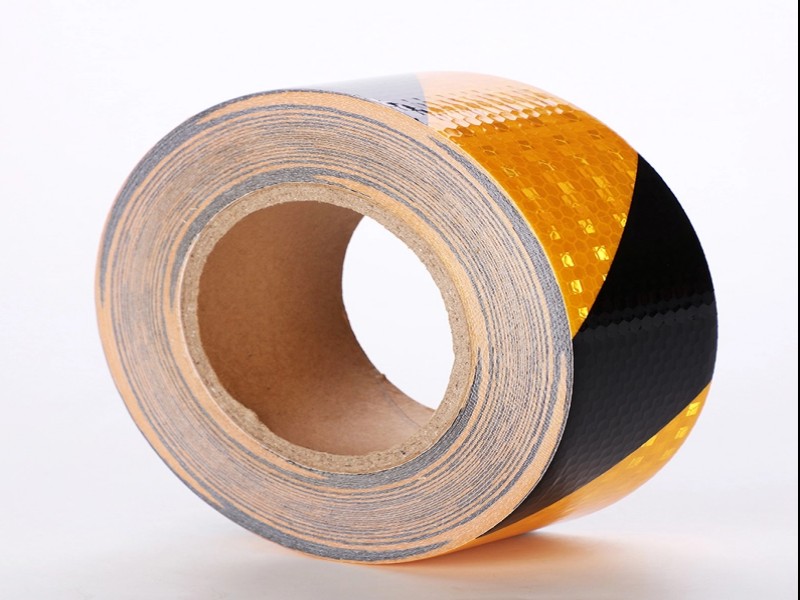
The optical behavior of glass bead Reflective Tape can be understood as a controlled sequence of bending and redirection. When light strikes the tape, it first passes through the transparent outer film and enters a glass bead. Because glass has a higher refractive index than air, the light bends inward as it enters the spherical surface. This refraction concentrates the beam toward the rear portion of the bead.
Once the light reaches the back of the bead, it encounters the reflective backing layer. At this stage, reflection occurs, redirecting the beam back through the bead. As the light exits the bead and transitions from glass back into air, it refracts again. The geometry of the sphere ensures that the exiting beam travels in a direction close to parallel with its original entry path.
The process can be summarized in three optical steps:
● Refraction on Entry Light slows and bends as it moves from air into glass. This bending focuses the beam toward the bead’s rear surface and prepares it for redirection.
● Reflection at the Backing Layer The reflective coating returns the concentrated beam rather than allowing it to disperse into the substrate. This reflection stage is essential for retroreflection.
● Refraction on Exit As light leaves the bead, it bends again in a way that aligns its outgoing direction with the incoming path. This is what enables light to return toward the source.
Because millions of beads perform this sequence simultaneously, the combined effect produces a visible glow when illuminated.
Glass bead systems distribute returned light over a relatively wider area compared to prismatic designs. Instead of forming a sharply concentrated beam, the returning light spreads across a broader range of angles. This characteristic can be advantageous in situations where observers may approach from slightly varied positions.
However, the wider distribution also means that light intensity per unit area is lower than that of more advanced prism systems. The brightness is sufficient for many traffic and safety applications, but at longer distances or under high-speed driving conditions, bead-based Reflective Tape may appear less intense.
Typical performance traits include:
● Moderate but consistent brightness when the observer is aligned with the light source.
● Wider angular tolerance, allowing visibility from multiple nearby positions.
● Gradual reduction in brightness as observation angles increase.
In scenarios requiring maximum long-distance visibility, such as highway signage or large vehicle markings, glass bead systems may appear less intense compared to microprismatic alternatives. Nonetheless, their balanced light spread and cost efficiency make them widely used in general safety marking applications.
Microprismatic Reflective Tape replaces spherical beads with precisely engineered cube-corner prisms arranged in dense arrays. Each prism is typically formed from three perpendicular reflective surfaces that meet at a single point, creating a geometric structure capable of directing light with high efficiency.
Unlike bead systems, microprismatic designs do not rely on a separate reflective backing layer. Instead, the internal prism faces themselves act as reflective surfaces. The optical layer is sealed beneath a protective top film to maintain structural integrity and prevent contamination. Because retroreflection depends heavily on geometric accuracy, manufacturing precision is critical. Even minor deviations in prism angles can reduce performance.
Key structural characteristics:
● High-density arrays of cube-corner microprisms molded into a transparent polymer.
● Internally reflective prism faces that eliminate the need for metallic backing.
● Protective sealing layers that maintain alignment and durability over time.
The result is a more controlled and efficient light-return system.
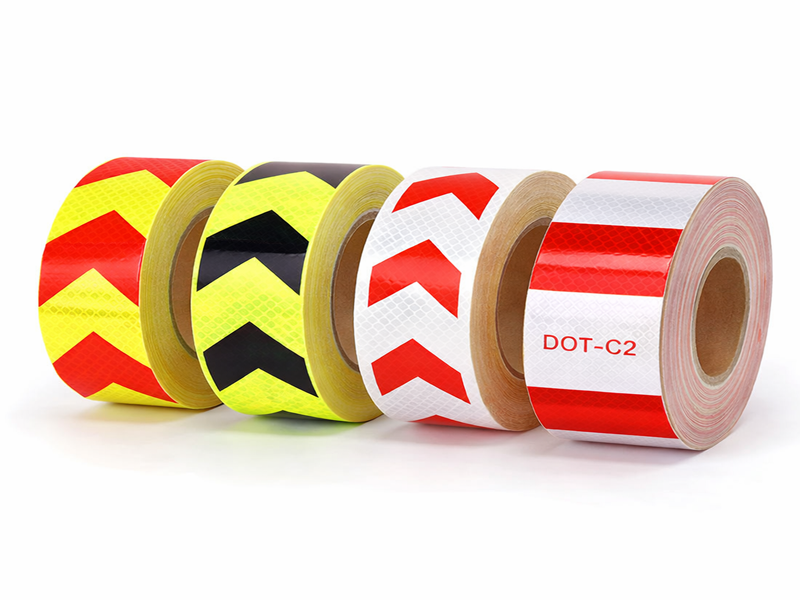
Microprisms return light using multiple internal reflections within the cube-corner geometry. When light enters the prism, it strikes one reflective face and is redirected toward a second face, then a third. After these sequential reflections, the beam exits the prism traveling nearly parallel to its original path.
This multi-surface reflection process minimizes light loss because the beam does not depend on a separate backing layer. Instead, the geometry itself ensures directional return. The precision of the cube-corner structure concentrates more of the incoming light into a focused beam.
Compared to glass bead systems:
● Light dispersion is reduced.
● Energy loss within the material is minimized.
● More of the incoming light is preserved and redirected toward the source.
This is why microprismatic Reflective Tape is often described as delivering higher-intensity retroreflection.
Because microprisms return a larger proportion of incoming light in a concentrated path, the reflected beam appears more intense to observers positioned near the light source. Instead of spreading light broadly, the system channels it into a narrower return pattern, increasing luminance.
The practical implications of this design include:
● Greater detection distance under headlights.
● Improved clarity of reflective markings at higher vehicle speeds.
● Stronger visual contrast in low-light conditions.
In real-world nighttime driving, viewers often notice that microprismatic Reflective Tape maintains brightness even at longer distances where bead-based materials may appear dimmer. The difference is not due to additional light production, but rather improved optical efficiency and geometric precision.
By comparing glass bead and microprismatic technologies, it becomes clear that both achieve retroreflection through controlled light redirection—but the method of internal reflection and the resulting light distribution determine overall intensity and performance range.
Reflective Tape works through retroreflection. It does not produce its own light. Glass beads and microprisms use different inner designs. Both return light to its source. Viewing angle affects brightness. Alignment controls what you see.
Zhejiang Quansheng New Material Technology Co., Ltd. offers durable Reflective Tape solutions. Their products deliver strong visibility and reliable safety value.
A: Reflective Tape uses retroreflection to return light to its source, increasing visibility when illuminated by headlights or directed light.
A: Glass bead Reflective Tape spreads returned light broadly, while microprismatic designs concentrate light for higher intensity and longer detection distance.
A: No. Reflective Tape is a passive material that relies entirely on external light sources and geometric redirection.
A: Reflective Tape brightness depends on entrance and observation angles; misalignment reduces the returned light reaching the viewer.


